


Introduction – Why Patient Call Systems Matter in Modern Healthcare
Effective communication between patients and caregivers is the cornerstone of safe, high-quality healthcare.
In hospitals, clinics, and long-term care facilities, patient call systems enable fast and reliable communication, reducing response times and improving overall patient satisfaction.
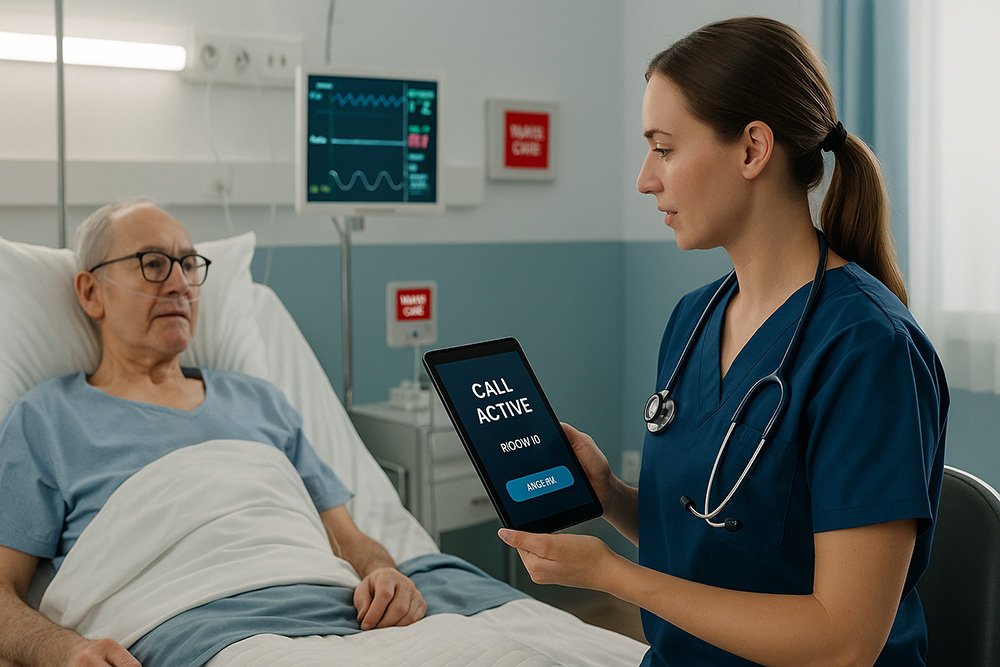
With the rise of digital transformation and smart healthcare technologies, managers now have access to advanced solutions that go beyond simple call buttons. Modern systems integrate voice, wireless alerts, mobile apps, and real-time analytics, creating a connected and responsive care environment.
 Patient and nurse sitting at reception desk, talking to female receptionist about disease diagnosis and healthcare support. Diverse people working in health center at registration counter.
Understanding the Basics: What Is a Patient Call System?
A patient call system is a communication network designed to allow patients to alert nurses or caregivers instantly when they need assistance.
Traditional models involved wired buttons connected to a central nurse station, while today’s systems use wireless transmitters, IoT connectivity, and cloud-based dashboards for greater flexibility.
The core components usually include:
Call Buttons or Pull Cords – Installed near patient beds or bathrooms.
Nurse Station Consoles – Display incoming alerts and room numbers.
Wireless Transmitters or Hubs – Send signals throughout the facility.
Mobile Devices – Allow caregivers to receive alerts anywhere.
Data Logging Systems – Record response times and usage history.
Modern systems are modular, scalable, and can be integrated with other hospital management tools such as electronic medical records (EMR) and building automation systems.
Types of Patient Call Systems: Wired vs. Wireless
When choosing a system, healthcare managers should first decide between wired and wireless configurations.
1. Wired Systems
Reliable and less prone to signal interference
Ideal for new construction or large hospitals
Require professional installation and maintenance
2. Wireless Systems
Easier to install, especially in existing buildings
Offer mobility and flexibility for staff
Can be expanded or upgraded with minimal downtime
For facilities planning renovations or expansions, a hybrid system—combining wired and wireless elements—offers the best of both worlds.
 Asian Doctor make routine health check with patient in hospital ward
Key Features to Look for in Modern Patient Call Systems
1. Real-Time Communication
Advanced systems enable instant two-way voice communication between patients and caregivers.
This reduces unnecessary trips to patient rooms and ensures accurate understanding of each call’s urgency.
2. Priority and Escalation Alerts
Systems can categorize calls based on urgency—emergency, routine, or technical request—and escalate alerts automatically if unanswered within a defined timeframe.
3. Integration with Mobile Devices
Nurses can receive calls on smartphones or pagers, ensuring constant connectivity even when away from the nurse station.
4. Data Analytics and Reporting
Built-in analytics provide insights into response times, staff performance, and workflow optimization.
This helps management track service quality and allocate resources effectively.
5. Compatibility and Scalability
Ensure that the chosen system can integrate with other facility technologies (e.g., fire alarms, EMR systems, or building control networks).
Scalability is essential for growing institutions that plan to add more wards or devices.
6. Infection Control Design
Touchless or antimicrobial materials are becoming standard in healthcare environments.
Choosing call units that are easy to sanitize improves patient safety and compliance with hygiene regulations.
Evaluating Vendors and Technology Partners
Selecting the right vendor is as important as choosing the system itself. Healthcare managers should evaluate suppliers based on:
Experience in healthcare integration projects
Certifications such as ISO 13485 (medical device quality) or CE marking
Post-installation support and service response times
Customization capability to match facility needs
User training and documentation for staff onboarding
Many facilities benefit from partnering with vendors who provide end-to-end solutions—from system design and installation to software maintenance and technical upgrades.
Cost Considerations and ROI Analysis
Investing in a patient call system should not be viewed as an expense but as a long-term operational investment.
The return on investment (ROI) comes from:
Reduced staff workload and response times
Improved patient satisfaction scores
Fewer communication errors or safety incidents
Enhanced data for accreditation and quality audits
While basic wired systems are more affordable upfront, wireless and smart systems offer greater flexibility and future-proof value, often offsetting initial costs within two to three years.
Compliance and Safety Standards
Before purchasing, ensure the system meets healthcare safety and compliance requirements such as:
UL 1069 (Hospital Signaling and Nurse Call Equipment)
ISO 7396 (Communication and Safety Systems for Hospitals)
IEC 60601 (Medical Electrical Equipment Safety)
Compliance ensures that the system performs reliably under emergency conditions and qualifies for insurance or government health certifications.
Implementation Tips for Healthcare Managers
Conduct a site audit: Assess coverage areas, power availability, and interference risks.
Engage clinical staff: Their feedback ensures the system matches real-world workflow.
Start with pilot testing: Install in one ward to measure performance and gather user feedback.
Plan for scalability: Choose systems with modular architecture to expand as needs grow.
Train your staff: Regular training reduces response time and improves adoption rates.
Case Study Example: Smart Wireless Call System in a Mid-Size Hospital
A 250-bed private hospital upgraded from a wired system to a smart wireless patient call solution.
After deployment, average nurse response time dropped from 2.5 minutes to 1.1 minutes.
Staff efficiency improved by 30%, and the facility gained better data for accreditation reports.
This success attracted additional investment and improved patient satisfaction scores.
For B2B vendors, this illustrates how patient call systems create measurable business value.
Conclusion – Building a Smarter, Safer Healthcare Environment
Choosing the right patient call system is about more than technology—it’s about empowering caregivers and ensuring patient safety.
Modern solutions combine mobility, analytics, and automation to support efficient workflows and enhance quality of care.
For healthcare managers and B2B partners, investing in the right system means building a connected healthcare ecosystem that’s safer, smarter, and ready for the future of patient-centered care.
 MEEYI
MEEYI